
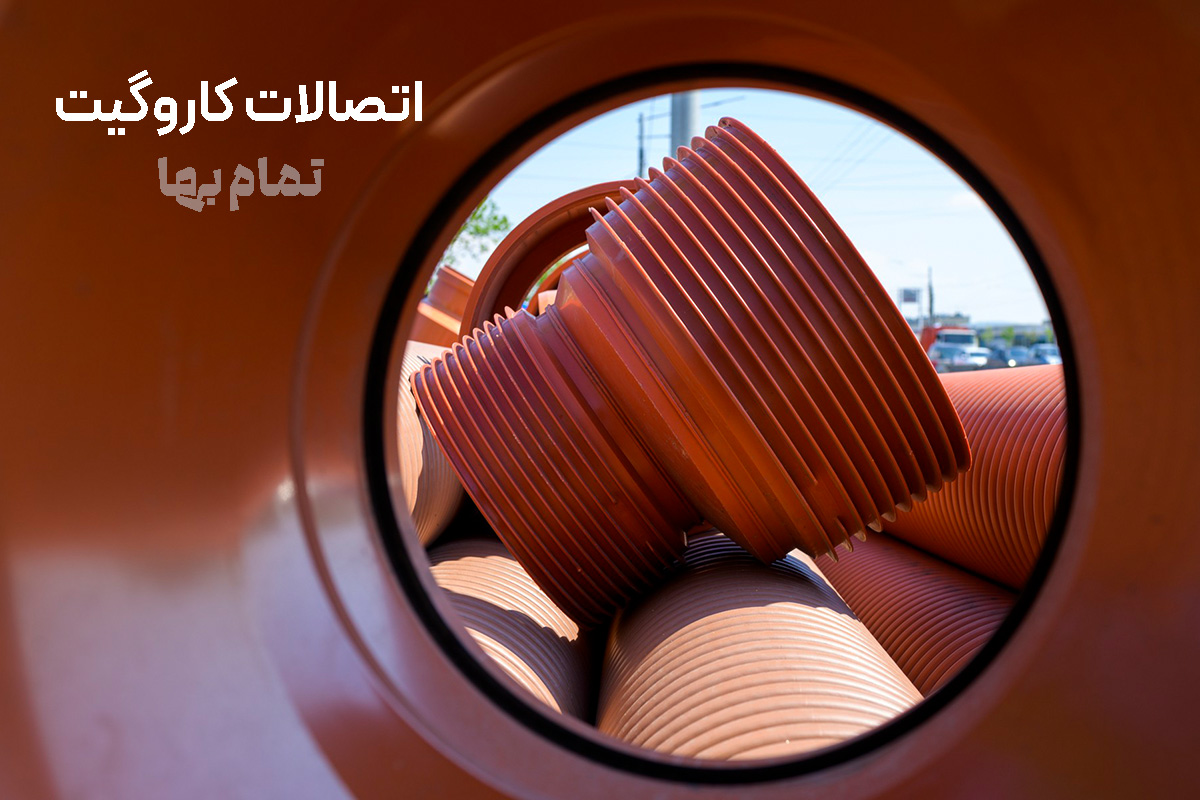
Corrugated fittings are recognized as the backbone of many modern infrastructure networks—systems that must withstand hydraulic and mechanical pressures, temperature variations, chemicals, and impact loads while remaining simple to install and maintain. This combination of seemingly conflicting demands is precisely what makes corrugated fittings a strategic option for sewer systems, drainage, industrial fluid transfer, and ventilation systems.
Evolution of Corrugated Fittings in Industry
The first generation of corrugated fittings was introduced more than five decades ago to replace concrete and metal sections in urban sewer lines; however, concurrent advances in polymer science, rotational molding (Rotational Molding), and dual-wall spiral extrusion (Dual-wall Extrusion) quickly paved the way for these fittings to penetrate the petrochemical, mining, and agriculture industries—and even clean-air transfer lines. Recent generations, leveraging special grades of high-density polyethylene (HDPE) and crystalline polypropylene (PP-B/H), not only deliver higher ring stiffness but also resist environmental stress cracking (ESCR) and impact at sub-zero temperatures.
Material Structure and Key Properties
Polyethylene (HDPE): excellent flexibility, impact resistance down to −30 °C, and clean weldability.
Polypropylene (PP-B): higher modulus of elasticity and heat resistance (up to 90 °C), ideal for hot lines or environments containing light hydrocarbons.
Anti-chemical compounds: formulations enriched with RU stabilizer and coarse-grade carbon black to mitigate the corrosiveness of strong acids and bases.
Distinct Technical Advantages
Lightweight → 30–70% lower transportation cost compared to metal or concrete sections.
Excellent corrosion resistance → design life of 50 years at pH 1.5 to 13.
Fast, low-cost installation → possibility of pre-assembly in the workshop and push-fit sealing with EPDM O-ring.
Ring flexibility → tolerates soil settlement and earthquake-induced movements up to 7% of diameter.
Table ❶ – Technical Comparison of Three Common Joining Systems
| Key Feature | Corrugated Fittings | Alloy Metal Fittings | PVC-U Fittings |
|---|---|---|---|
| Specific Gravity (g/cm³) | 0.94–0.97 | 7.8 | 1.4 |
| Corrosion Resistance | Very high | Low (requires coating) | Medium |
| Installation Speed (m/h) | 20–25 | 7–10 | 15–18 |
| Allowable Deformation Limit (%) | 5–7 | < 1 | 3–4 |
| Operating Temperature Range (°C) | −30 … +80 | −10 … +120 | 0 … +60 |
Types of Corrugated Fittings and Specialized Applications
Sleeve Coupler: the most common option for line extension; features two EPDM sealing rings and an internal stiffener.
45° and 90° elbows: change direction without cutting the pipe; concentric geometry reduces local head loss.
Injection-molded tees and crosses: balanced flow distribution; sizes 160 to 1200 mm with coaxial reducing branches.
Flanged (Stub End + Loose Flange): connection to pumps, valves, or pressure vessels; PTFE or CNAF gasket per DIN 2690.
Application Domains
Urban wastewater and effluent systems, open-pit mine drainage, acid return lines in refineries, fiber-optic cable ducts, air-transfer networks in metro tunnels, and green-roof rainwater collection systems are among the most prominent areas of use. Each prefers corrugated fittings over other options due to the blend of chemical resistance, light weight, and flexibility.
Selection and Joint Design Parameters
Design pressure (PN): for gravity networks < 0.5 bar, push-fit is sufficient; in pumped lines up to 4 bar, use extrusion welding or electrofusion.
Fluid type: fluids with high TSS or sulfuric acid require a smooth inner layer with an Anti-Abrasion compound.
Thermal conditions: for −20 to +70 °C fluctuations, consider a longitudinal expansion coefficient of 1.3 mm/m/10 K and recommend an expansion spacer.
UV considerations: exposed lines must be stabilized with carbon black ≥ 2%; in mountainous regions at altitudes > 2000 m, use a PE-UV jacket.
Installation Methods and Reference Standards
Push-fit with rubber O-ring — the fastest method for gravity sewers; per DIN 16961 Part 2.
Butt fusion — for pressure lines up to PN 10; jaw temperature 200 ± 10 °C and weld pressure 0.15 N/mm².
Bolted flange — at access points and valves; drilling per EN 1092-1.
Quality-control standards include ASTM F894 for ring stiffness testing, ISO 13967 for joint permeability, and ISIRI 10315 for national installation requirements.
Table ❷ – Recommended Maintenance Schedule for Corrugated Piping Systems
| Activity | Suggested Frequency | Tool or Method |
|---|---|---|
| Visual inspection of joints and O-rings | Every 12 months | HD CCTV camera |
| Gravity pressure test (Leak Test) | Every 5 years | Line isolation and 5 m water column |
| Mechanical descaling | Depends on fluid TSS; typically 24–36 months | Pig brush or 180 bar water-jet |
| ESCR monitoring | Every 10 years or after earthquake > 5 Mw | Sampling coupons & ASTM F2136 test |
Limitations and Engineering Mitigations
Corrugated fittings are not the first choice for pressures above PN 10; in such cases, switch to spiral-wound pipes reinforced with steel profiles or use composite overlays to increase ring modulus. Direct sunlight without a protective layer can, over time, cause yellowing and reduced impact resistance; soil cover or UV-Shield coatings are the common engineering remedies. Finally, precision during welding or fitting is essential for complete sealing, and trained specialists are necessary.
Industrial Manufacturing Process
Dual-wall extrusion lines first form the polymer melt into a smooth cylinder, then—immediately in a grooved vacuum mold—simultaneously shape the corrugated outer wall and smooth inner wall. After spray-ring cooling, the pipe is cut into 6 or 12 m lengths. Injection-molded fittings are produced on 800 to 2400-ton machines and then joined to the pipe body by extrusion welding or heat caps. Dimensional control with 360° laser scanning and an internal pressure test at 0.5 bar for 30 minutes ensures the quality of each piece.
Engineering Purchasing Guide
For optimal selection, first define the project’s temperature and pressure range, then determine the size (ID/OD) and ring-stiffness class (SN4, SN8, or SN16). Choose a manufacturer that provides a ring-stiffness test certificate, a base-resin report with MFR and density, and a written warranty of at least 10 years. Price comparison by meter alone is misleading; be sure to consider unit weight, wall thickness, and gasket quality. After-sales service and rapid availability of couplers and elbows in large diameters are also key to successful maintenance operations.
Tamam Baha Store, as one of the authorized suppliers of a complete range of corrugated pipes and fittings, facilitates engineers’ and contractors’ access to quality products by maintaining continuous stock in 110–1600 mm diameters, offering pre-purchase technical advice, and providing swift nationwide dispatch; of course, customers may continue to purchase from other reputable suppliers, and Tamam Baha is simply one of the reliable choices in the market.