
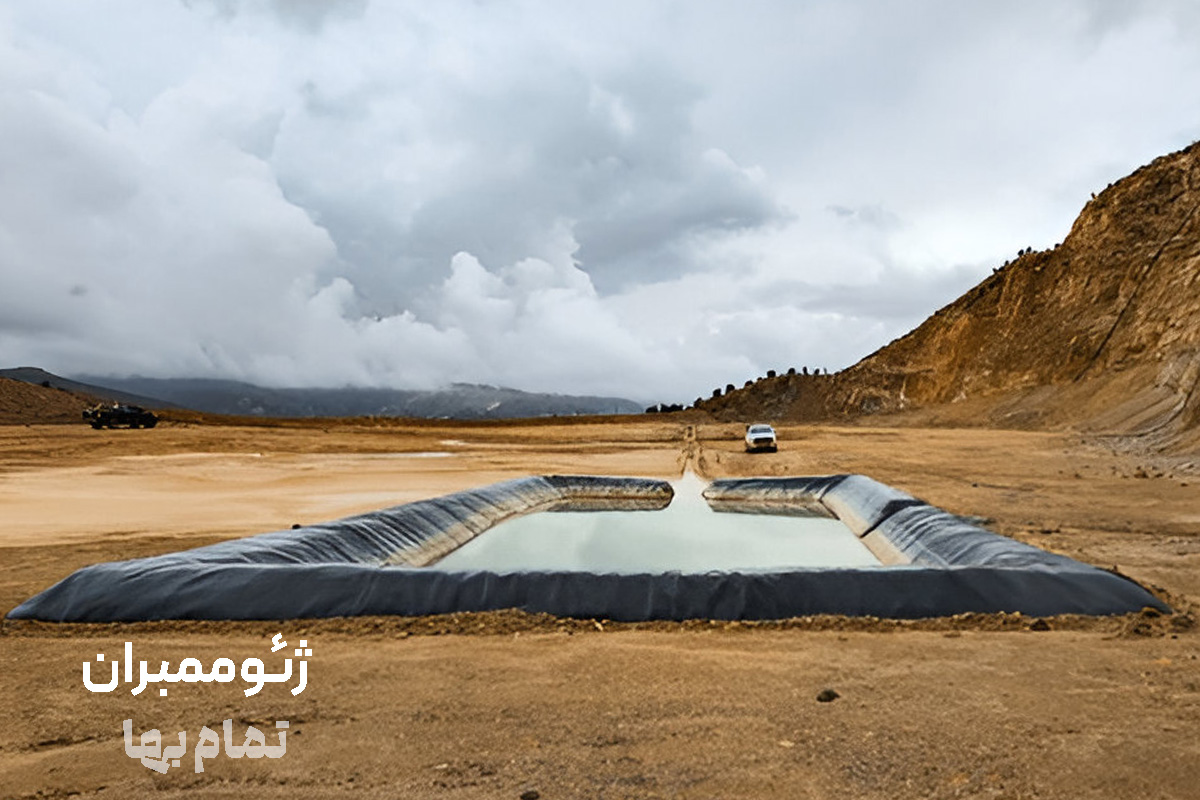
Geomembranes as a foundational solution in geotechnical isolation have undergone remarkable transformation over the past five decades and are now an integral component of landfill designs, liquid storage, earth dams, evaporation ponds, hydraulic structures, and even urban green roofs. In this text, with depth beyond a simple product introduction, everything needed for selecting, designing, installing, and maintaining these polymeric liners—from the finest technical details to future trends—is examined to provide a comprehensive reference for engineers, practitioners, and decision-makers.
1. Historical trajectory and drivers of development
1967–1975: The first polyethylene waterproofing films were installed in agricultural projects in the United States. The absence of UV-resistant additives limited their service life to under 5 years.
1976–1984: Environmental crises from infiltration of municipal leachate prompted the U.S. EPA to formulate the “Secure Landfill Standard”; mandatory use of HDPE geomembranes began in this period.
1985–2000: The emergence of LLDPE resins with linear molecular-weight distribution transformed installation flexibility. In Europe, tests EN 13361 and EN 13491 became the basis for CE approval.
2000–present: Nanotechnology, the addition of uniformly dispersed carbon black < 25 nm, and compositing with woven geotextile increased puncture resistance up to threefold. Integrated fiber optics as deformation sensors have enabled continuous monitoring of earth dams.
2. Layered structure and advanced formulation
Modern sheets are produced as three-layer co-extrusions:
Core Layer: HDPE or PP with density 0.94–0.96 g cm⁻³ serving as a physical barrier to gas and liquid.
Tie-Layer: Ethylene-co-vinyl-ester with 4–5% vinyl content; absorbs bending and thermal stresses.
Cap Layer: Polyolefin–carbon black blend with Type I and II antioxidants; the first line of defense against photo-oxidation.
Additives include HALS (hindered amine light stabilizers), montmorillonite nanoclay to reduce permeability, and polyolefin wax to improve slip during welding.
3. Technical performance indices
Permeability (k): For 2 mm HDPE, about 10⁻¹⁴ m s⁻¹—four orders lower than water-tight concrete.
Modulus: HDPE ≈ 800 MPa; LLDPE up to 500 MPa; this difference governs the allowable bending radius in pond corners.
Thermal stability: With OIT (oxidative-induction time) > 100 min, a 100-year service life at 25 °C for landfills is reasonable.
Chemical resistance: HDPE is stable against mineral acids and strong bases; PVC is vulnerable to aromatic solvents; EPDM is most resistant to ozone and UV but shows loss of mechanical properties in dilute sulfuric acid.
4. Engineering analysis and design
Slope design, stresses, and subgrade compatibility require limit-equilibrium modeling with the following parameters:
Friction angle between geomembrane and soil (φ ≈ 13° for smooth, 23° for textured surfaces).
Factor of safety against sliding on landfill slopes (target: ≥ 1.3).
Differential settlements; in soft soils, a geotextile + geogrid layer beneath the sheet is recommended so liner strain does not exceed 5% strain.
For dams taller than 30 m, compute hydrostatic pressure and determine anchor-trench spacing.
5. Standards and legal requirements
GSI-GM13 / GM17: Physical and OIT requirements for HDPE and LLDPE.
ASTM D4437 & ISO 12236: Test methods for welding and puncture resistance.
EN 13362: Application of sheets in green roofs and small reservoirs.
In Iran, Publication 308 (Management & Planning Organization) together with ISIRI Standard 16110 defines project specifications for geomembranes. Project managers must verify factory reports against the “nominal-to-minimum thickness control” clause before shipment.
6. Manufacturing methods
Blown-Film: Most common; uniform thickness but width limited to 8 m.
Flat-Die (Cast): More precise thickness control; widths up to 15 m but higher capital cost.
Calendered PVC: Suitable for 0.5–1.5 mm; very high flexibility and used in metro tunnels.
7. Field installation
The subgrade must have at least a 2% slope toward the leak-collection channel. Laser leveling after compaction to 95% Proctor is verified. A protective geotextile layer—polypropylene fibers 400 g m⁻²—ensures reduction of concentrated stresses.
Key stage — Main activity — Specialized tools — In-process QC
Sheet deployment — Roll-out along slope — Pay-off / spreader bar — Visual inspection for wrinkling
Dual-track welding — Hot-wedge at 2–3 m min⁻¹ — Dual-track welder — Vacuum-box test at 30 kPa
Extrusion welding — Edge reinforcement and patches — 4 kg h⁻¹ extruder — Peel/impact test per ASTM D7003
Air-channel test — 5 min at 27 kPa — Digital manometer — Digital weld logbook
Protective cover — Opportunity geotextile layer — GPS-equipped grader — Spot compaction tests
8. Quality control and assurance (QC/QA)
Factory: 100% of rolls must carry certificates for MFI, OIT, and tensile properties.
Field: For every 300 m of weld, a dedicated tensile–shear specimen is tested in a mobile lab.
Post-construction: An LCS (leak-location survey) by electrical method every five years is recommended for evaporation ponds.
9. Long-term maintenance and smart monitoring
LLD (Leak Location Detection) systems use a reference ground electrode + conductive geomembrane (conductive HDPE) to detect leaks > 1 mm in any 5 cm segment. Brillouin fiber-optic data enabled detection of 10 µε strain in China’s “Jokageba” dam. For chemical ponds, temperature monitoring with DTS cables reveals heat from chemical reactions to prevent thermal tearing.
10. Life-cycle assessment and economic analysis
The initial cost of a 2 mm HDPE sheet (one 7×100 m roll) in Iran is about X rials. Adding 5% for transport and 12% for installation, and assuming a 50-year service life with a 10% discount rate, the unit NPV is lower than that of a clay liner with permeability 10⁻⁷ m s⁻¹, because operating costs for leachate collection and groundwater monitoring are dramatically reduced.
11. Environmental aspects and sustainability
Based on ISO 14040, the carbon footprint per square meter of 2 mm HDPE is approximately 5.2 kg CO₂-eq; however, methane reduction from a 100 t day⁻¹ municipal landfill over 20 years corresponds to avoiding > 400,000 t CO₂-eq—far outweighing the carbon capital of geomembrane production. End-of-life recycling via pulverization and use in geocomposite structures strengthens a closed-loop materials cycle.
12. Emerging technologies
Graphene-reinforced sheet: Adding 0.2 wt% graphene oxide increases tensile strength by 25% and doubles thermal conductivity for dissipating reaction heat.
Self-Healing Capsules: Moisture-activated polyurethane microcapsules in a 50 µm layer; seal cracks up to 0.3 mm within 24 h.
Sensors-on-Roll: RFID barcodes replace traditional labels, enabling full supply-chain traceability into BIM.
13. Complementary application domains
Oil & gas projects: Multilayer HDPE/LLDPE-EVOH gasoline-vapor barriers in tank farms reduce VOC concentrations by up to 90%.
Chemical industries: Phosphoric-acid ponds at fertilizer plants using scrim-reinforced HDPE remain stable at 85 °C.
Mining engineering: In gold leaching ponds, the geomembrane with geodrain prevents cyanide–soil contact and facilitates solution recovery.
Urban infrastructure: In deep metro-tunnel linings with 1.2 MPa hydrostatic pressure, co-extruded PVC with internal fiberglass mesh is used, reducing allowable leakage to < 0.1 L min⁻¹ 100 m⁻².
14. Comprehensive selection and procurement guideline
Prepare a six-criteria decision matrix (chemical resistance, UV, flexibility, allowable stress, cost, legal requirements) and assign weighted scores to each option.
Before tender, visit the factory to observe the resin blending system and 5-layer extruder.
Include a “payment conditional on field-test approval” clause so quality risk is naturally shared between owner and contractor.
Key property — HDPE — LLDPE — PVC — EPDM — PP
Permeability (m s⁻¹) — 10⁻¹⁴ — 10⁻¹³ — 10⁻¹² — 10⁻¹² — 10⁻¹³
OIT (min) — > 100 — > 90 — 30–60 — 20–40 — > 80
Elongation at break (%) — 13 — 700 — 320 — 500 — 600
UV saturation (kLy) — 120 — 110 — 70 — 150 — 100
Indicative use — Industrial landfill — Agricultural pond — Urban channel — Green roof — Oil tank
15. Executive site summary
Dual welding thermometer: A ±5 °C difference between the display and the reference thermocouple indicates a need for calibration.
Roll handling: Each roll must be moved with a forklift using rubber clamps; metal tines cause white stress marks.
Anchor trench: At least 0.6 m deep with a 60° angle in dense soil is recommended to prevent liner pullout in shrimp ponds.
Tamam Baha, a reputable domestic supplier, provides HDPE, LLDPE, and PVC geomembranes in 1–3 mm thicknesses through a network of ISO 9001-certified plants. In addition to on-site delivery, optional support services include drafting QC plans, deploying certified welding crews, and performing LCS testing. Clients—whether in Iran or abroad—may, of course, select alternative vendors or combine local and international sources based on technical and economic considerations.