
Polyethylene sheet has, thanks to its unique combination of chemical stability, flexibility, and competitive price, attained a vital position in the supply chain of many industries over recent decades. From fluid transfer lines to food packaging, these sheets create a strategic advantage in weight reduction, installation speed, and long-term durability—making them the default choice for engineers, designers, and professional buyers.
Scientific Roots and Industrial Evolution of Polyethylene
Low-density polyethylene was first discovered in a high-pressure reaction in 1933—a breakthrough that paved the way for research into chain structure and property modification of this polymer. Four decades later, Ziegler–Natta and subsequently metallocene catalysts enabled precise design of molecular weight and degree of branching. The outcome was the birth of diverse grades such as HDPE, LLDPE, and MDPE, each opening new windows of applications—from thick geomembranes to super-clear films.
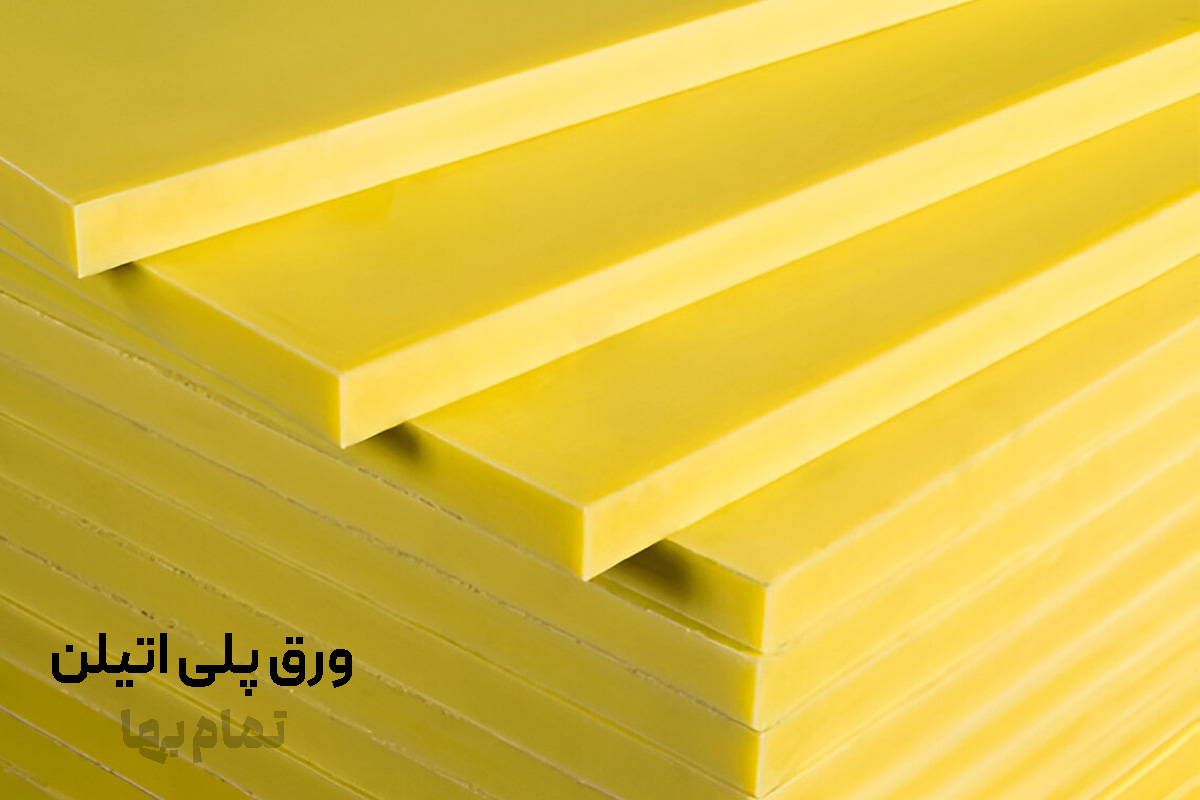
Sheet Manufacturing Process: From Pellets to Engineering Sheet
- Direct extrusion (Sheet Line) – After melting at 180–220 °C, pellets exit uniformly as a flat ribbon through a slot die.
- Vacuum calibration – Vacuum rolls control thickness to ±2% accuracy and minimize residual stresses.
- Stepwise cooling – Passing through six to eight roller chillers with gradual temperature differences suppresses sudden shrinkage and yields a wave-free sheet.
- Cross and longitudinal trimming – CNC carbide saws with diamond edges deliver clean, burr-free edges—a key for subsequent sealing.
Grades and Crystalline Structure
LDPE (ρ≈0.915 g/cm³): high branching → high clarity and flexibility.
LLDPE (ρ≈0.918 g/cm³): short linear branching → balance of strength and toughness.
HDPE (ρ≈0.950 g/cm³): high crystallinity → superior hardness, modulus, and chemical resistance.
Table 1 – Technical specifications of the main grades
| Sheet Type | Density (g/cm³) | Operating Temp (°C) | Tensile Strength (MPa) | Elongation (%) |
|---|---|---|---|---|
| LDPE | 0.910–0.925 | −50 … +75 | 8–12 | 300–650 |
| LLDPE | 0.915–0.930 | −60 … +85 | 10–18 | 500–900 |
| HDPE | 0.940–0.965 | −80 … +110 | 19–35 | 200–700 |
Key Physical and Mechanical Features
- Custom density: Precise control of crystallinity allows tuning specific gravity to meet handling or buoyancy requirements.
- Exceptional impact resistance: Fracture energy above 100 kJ/m² makes it ideal for impact-prone tanks and drywall laminates.
- Moisture impermeability: Water-vapor transmission rate under 1 g/m²·day at 1 mm thickness readily meets IP-67.
- Controlled rheology: Melt flow index (MFI) from 0.3 to 25 g/10 min provides a wide window for fast extrusion or precise thermoforming.
Applications in Strategic Industries
Energy and pipeline industry
HDPE sheet used as an internal liner for steel pipes reduces corrosion rates by up to 98% and extends crude-oil pipeline service life from 15 to over 45 years. In buried gas lines, electrofusion between sheet and spool enables 100% sealing.
Civil engineering and geosynthetics
Geomembranes of 2–3 mm with creep crack stress below 3 MPa are ideal for lithium-recovery ponds and tailings dams. UV-stabilized properties retain ≥80% of initial strength after 15 years of direct sunlight.
Food industry and smart packaging
Multilayer LLDPE/PA/PE films act as an oxygen barrier, doubling to tripling the shelf life of protein products. Adding silver nanoparticles to the inner layer suppresses bacterial growth by up to 99.9% without migrating into the edible phase.
Sustainable agriculture
Matte-black LLDPE sheets at 120 µm reduce surface evaporation by 70% and herbicide use by 55%. In thermal mulches, dual-side white/black coatings keep soil temperature variation within ≤1.5 °C over the diurnal cycle—key for uniform germination.
Key Advantages and Limitations vs. Alternatives
| Feature | Polyethylene Sheet | Rigid PVC | Polypropylene |
|---|---|---|---|
| Impact resistance | Very high | Medium | High |
| Continuous temperature tolerance | Up to 110 °C | Up to 70 °C (unreinforced grade) | Up to 130 °C |
| Low-temperature toughness | Excellent (to −80 °C) | Poor (brittle below 0 °C) | Good (−20 °C) |
| Surface hardness | Low–Medium | High | Medium |
| Economic recycling | Easy | Limited to stabilized grades | Medium |
| Chlorinated gas & strong acids | Resistant | Sensitive to chlorine | Resistant |
Advanced Installation and Maintenance Strategies
- Single-pass extrusion welding: For thicknesses ≥10 mm, a 230 °C nozzle temperature and 0.3 N/mm line pressure ensure optimal penetration.
- Fusion bonding: On flat surfaces, a 200 °C plate heater and 0.02 MPa pressure produce a homogeneous joint; after 5 minutes of cooling, residual stress is <10%.
- Periodic monitoring: A 15 kV spark test every 36 months and tensile testing on punch-out seam samples are practical indicators for molecular degradation assessment.
Market and Technology Outlook
According to demand-forecast models, consumption of PE sheets with antimicrobial and anti-abrasion additives will grow at a 6.8% CAGR through 2030. Development of PE/graphene nanocomposites boosts flexural modulus by over 40%, enabling thickness reduction without performance loss—a direct advantage in lowering production cost and carbon footprint. The arrival of fourth-generation organometallic catalysts will also deliver ultra-crystalline polymers with more uniform molecular weight and faster processability.
Tamam Baha, through its specialized distribution network, offers a complete range of polyethylene sheets in diverse grades and thicknesses, along with custom cutting, quality test certificates, and fast delivery to major cities—helping customers in infrastructure, food, and agriculture projects keep production and execution running without material-supply interruptions.